Produce requirements work products that are needed as
inputs by other teams on the endeavor (e.g., the architecture and independent testing teams).
Thereby help ensure that all endeavor effort is based on the implementation of properly approved requirements.
Minimize the risk of endeavor failure due to poorly engineered requirements work products.
Reduce endeavor costs.
Improve the quality of all endeavor deliverable work products.
Increase customer and user satisfaction.
For the [re]engineered business enterprise, the next
version [incremental iteration] of the application, the
component to be engineered, or the center to be developed,
produce a formally documented consensus among all endeavor
stakeholders (e.g., customer representatives, users, endeavor
champions, endeavor management, developers) concerning its:
Vision.
Requirements.
Scope.
Boundaries.
Provide input (e.g., number of use cases and use case
paths) to the endeavor’s cost and schedule estimation tasks.
Provide a basis (e.g., use cases and use case paths) for
the scheduling of the development cycle phases and builds.
Maximize the quality of the requirements and other
requirements work products (e.g., correctness, completeness,
consistency, testability, and understandability).
Maximize the productivity of the requirements teams
(e.g., reuse of requirements, reuse of conventions, and existence of examples).
Requirements engineering on a specific endeavor typically
consists of the appropriate subset of the following
requirements engineering tasks (and subtasks), which are
typically performed in an iterative, incremental, parallel, and time-boxed manner:
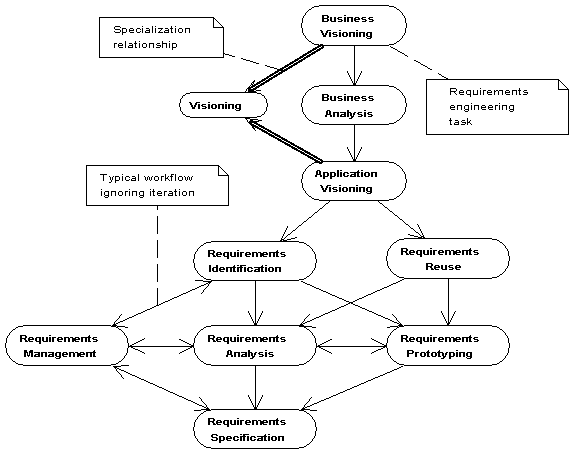
The following diagram illustrates the typical workflow of
the requirements engineering tasks on an application
development project if iteration is ignored:
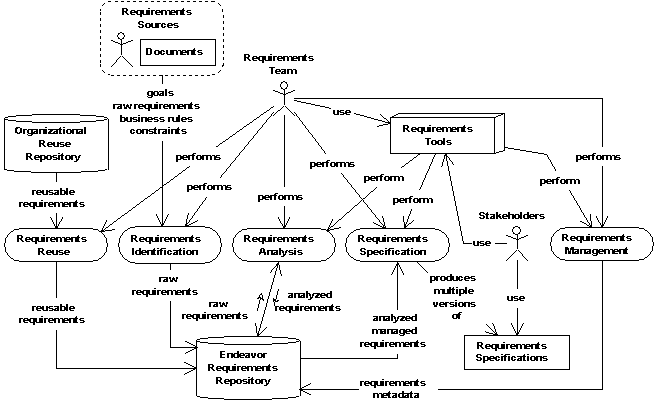
The following diagram illustrates one way in which the
requirements tasks, the producers (e.g., requirements team,
stakeholders, and requirements tools) that perform them, and
the associated repositories might be related on a project:
Requirements engineering typically involves the following
teams performing the following requirements tasks in an
iterative, incremental, parallel, and time-boxed manner:
Requirements Analysis,
by involving prioritizing the requirements from the standpoint of the development organization).
Related Tasks Allocated To Other Activities
Because the following tasks fit better under other activities, they are
not techically part of the requirements
engineering activity, although they nevertheless have a major impact on requirements engineering:
Scope Management,
which is a task of the management activity that manages major requirements changes that
change the scope of the endeavor.
Configuration Control,
which is a task of the configuration management activity that manages changes to baselined requirements
(and other) work products.
Quality Control,
which is a task of the quality engineering activity that controls the quality of requirements
(and other) work products (e.g., via the
requirements evaluation task).
Actor Cards, which are large index card used during
the requirements elicitation task to informally document
a single actor of the customer organization.
Use Case Cards, which are large index card used
during the requirements elicitation task to informally
capture the cohesive set of operational requirements
associated with a single use case of the customer
organization’s business enterprise.
Customer Stakeholder Profile, which documents the
various kinds of stakeholders in the customer
organization’s business enterprise.
Customer Analysis, which documents the results of the
analysis of the customer organization’s current
business enterprise.
Competitor Profile, which documents an individual
competitor of the customer organization.
Market Analysis, which documents the market in which
the customer organization’s applications must
compete.
Technology Analysis, which documents the results of
the analysis of technology trends that will impact the
customer organization’s applications.
Stakeholder Goals List, which documents the
stakeholder goals (desires, needs, and
expectations).
User Profile, which documents an individual type of
user or user organization.
User-Task Matrix, which is a matrix that documents
the tasks that users perform.
User Analysis, which documents the results of the
analysis of the user organizations of the customer
organization’s business enterprise.
Business Case, which documents the business case for
a potential business enterprise, application, component,
or center.
Business Vision Statement, which documents the
customer organization’s vision of its business
enterprise.
Glossary, which is used to formally define the
abbreviations, accronyms, and terms that are used within
the business enterprise.
Actor Cards, which are large index card used during
the requirements elicitation task to informally document
a single actor of the application.
Use Case Cards, which are large index card used
during the requirements identification task to informally
capture the cohesive set of operational requirements
associated with a single use case of the
application.
System Requirements Specification, which is used to
formally specify the functional requirements, quality
requirements, and design constraints.
External API Specification, which is used to formally
specify any external application programmer
interfaces.
Glossary, which is used to formally define the
abbreviations, acronyms, and terms used on an
endeavor.
Domain Model Document, which uses an object model to
formally document the relationships between application
domain concepts defined in the project glossary.
Having a solid requirements engineering process is
extremely important because:
Approximately 37% of defects originate during
requirements engineering.
Requirements defects that are not discovered until
after delivery cost approximately 200 times as much to fix
than if they were found during requirements
engineering.
Requirements defects account for some 70% of rework
costs.
Requirements defects consume from 25% to 40% of the
total project budget.
Of those projects that fail (i.e., significantly over
budget, significantly late, significantly lowered
functionality, cancelled, application never placed into
production), a large percentage do so because of poorly
performed requirements engineering and the resulting poor
quality of the requirements.
This activity should not be deleted, and care should be
taken to avoid tailoring out necessary and cost-effective
components of this activity.
Requirements engineering is important regardless of the
type of endeavor:
Building custom applications or components.
Building applications by integrating components.
Buying commercial-off-the-shelf (COTS) applications or
components.
Making major enhancements to existing applications or
components.
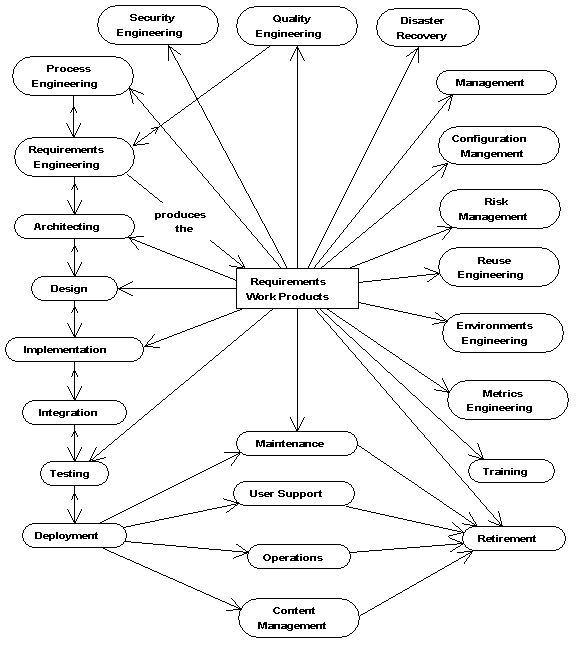
The following diagram illustrates the relationships
between requirements engineering and its associated work
products and the other activities. As you can see,
requirements engineering and its work products have a major
influence on almost all other activities.
This activity is documented using the typical configuration for large projects. It is intended to be
configured (i.e., instantiated, extended, and tailored) to meet the needs of specific projects.
The preconditions of this activity should be the union of the preconditions of its earliest constituent tasks.
The completion criteria for this activity should be the union of the postconditions of its constituent tasks.
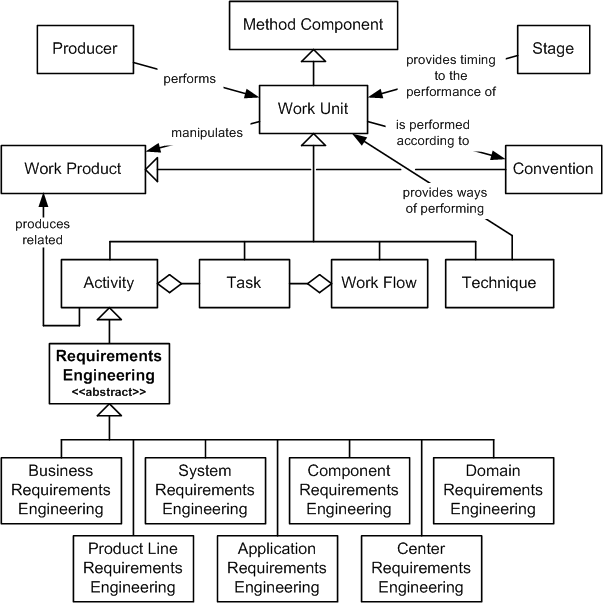
As an activity, requirements engineering inherits the
common guidelines of the
activity method component.