Disaster Recovery
Disaster Recovery
the activity
consisting of the cohesive collection of all
tasks
that are primarily performed to prepare for, avoid, react to, and recover from a major natural or man-made
disasters
As illustrated in the preceding figure, Disaster Recovery is part of the following inheritance hierarchy:
Type: AbstractSuperclass: Management Activity Subclasses:
System-specific Disaster Recovery
Application-specific Disaster Recovery
Contact Center Disaster Recovery (including all supported systems and applications)
Data Center Disaster Recovery (including all hosted systems and applications)
The typical responsibilities of Disaster Recovery are to:
Deal effectively with any disaster that has a significant probability of occurance.
Prepare an organization or business to deal effectively when a disaster occurs.
Take steps to avoid suffering a disaster in the first place.
Recover quickly and completely from any disaster that occurs.
Disaster recovery typically may begin when the following
conditions hold:
The endeavor has started.
The
disaster recovery team is adequately staffed.
One or more contact or data centers are either planned or
exist.
Disaster recovery is typically complete when the following
conditions hold:
When normal operations have been restored (for an
individual instance of disaster recovery).
When all contact and data centers have been retired (for
overall disaster recovery).
Disaster recovery typically involves the following producers
performing the following disaster recovery tasks:
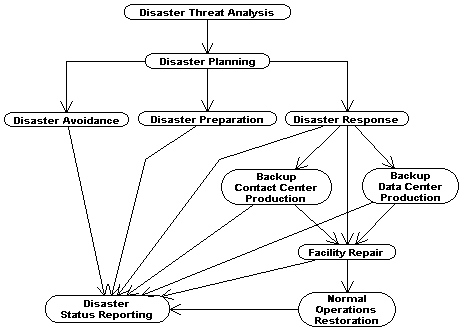
Disaster recovery tasks are typically related temporally as
illustrated in the following diagram:
Disaster recovery is typically performed using the following
environment(s) and associated tools:
Development Environment :
Word Processing Program (for documentation)
Spreadsheet Program (for capturing inventories)
Disaster recovery typically results in the production of all
or part of the following
disaster recovery work products :
Disaster recovery tasks are typically performed during the
following phases:
Phase
Relevant Tasks
Business Strategy
Not Applicable.
Business Optimization
Disaster Threat Analysis ,
Disaster Planning ,
Disaster Avoidance ,
Disaster Preparation ,
Disaster Response ,
Backup Contact Center Production ,
Backup Data Center Production ,
Facility Repair ,
Disaster Reporting , and
Normal Operations Restoration .
Initiation
Disaster Threat Analysis ,
Disaster Planning ,
Disaster Avoidance ,
Disaster Preparation ,
Disaster Response ,
Backup Contact Center Production ,
Backup Data Center Production ,
Facility Repair ,
Disaster Reporting , and
Normal Operations Restoration .
Construction
Disaster Avoidance ,
Disaster Preparation ,
Disaster Response ,
Backup Contact Center Production ,
Backup Data Center Production ,
Facility Repair ,
Disaster Reporting , and
Normal Operations Restoration .
Delivery
Disaster Avoidance ,
Disaster Preparation ,
Disaster Response ,
Backup Contact Center Production ,
Backup Data Center Production ,
Facility Repair ,
Disaster Reporting , and
Normal Operations Restoration .
Usage
Disaster Avoidance ,
Disaster Preparation ,
Disaster Response ,
Backup Contact Center Production ,
Backup Data Center Production ,
Facility Repair ,
Disaster Reporting , and
Normal Operations Restoration .
Retirement
Not Applicable.
This activity is documented using the typical
configuration for large projects. It is intended to be
configured (i.e., instantiated, extended, and tailored) to
meet the needs of specific projects.
The preconditions of this activity should be the union
of the preconditions of its constituent tasks.
The completion criteria for this activity should be the
union of the postconditions of its constituent tasks.