the managementwork product
that provides an exhaustive, hierarchical (top-down) tree structure overview
of the work to be performed to complete an
endeavor
Planned and actual start and stop dates are optional on
the WBS. They m
Use a standard project management tool to create and
maintain the WBS when the endeavor is not trivial in size and
complexity.
A large WBS should typically be produced in the form of a
hierarchically indented list, whereas A small WBS can also be
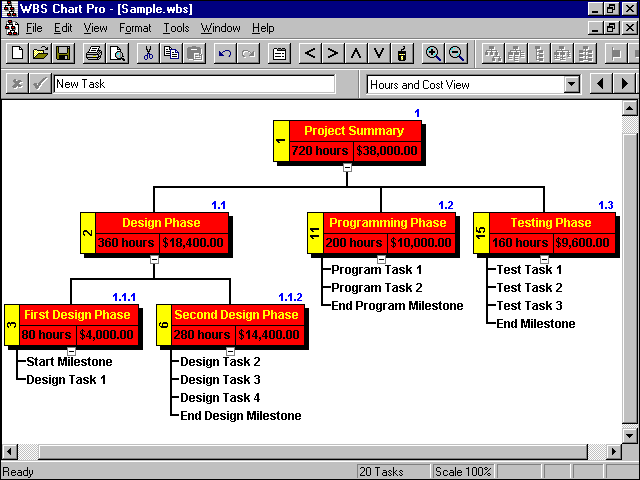
produced in the form of a chart (e.g., a hierarchical
decomposition tree). A WBS may also be produced in the form
of a table.
A WBS should primarily be hierarchically organized by
work products or by work units. Although a combination of
work products and work units is often used, care should be
taken to avoid any redundancy or overlap between WBS elements
except that which is implied by the decomposition
relationships between WBS elements.
Use a work-product-oriented WBS when the endeavor exists
to develop and deliver a system. Use a work-unit-oriented WBS
when the endeavor exists to provide a service.
When developing a WBS by work product decomposition:
Start with the system (or system of systems) and
decompose until reaching the appropriate level.
Include data, hardware, and software components within
the appropriate aggregate element rather than in a separate
WBS hierarchy. For example, a radar subsystem should
include both its hardware and software components.
If a WBS is organized by work products, then the
following should
NOT be elements of the WBS:
Documentation, which should be included with the
associated system, subsystem, etc.
Phases of development
Activities
Cost savings efforts such as total quality management
(TQM), quality assurance, and warranties
Rework, retesting, and/or refurbishing, which should be
included in the appropriate work product
Where practical, specify the tasks in terms of the work
products being produced, possibly in terms of percent
completed.
Include lines for all deliverable work products.
Do not use the WBS to micro-manage the project; limit the
tasks on the WBS to those having a reasonable duration.
Do not break down the work more than three levels unless
the endeavor is very large or the associated WBS elements are
of high cost or high risk.
Begin developing the WBS early in the endeavor and
maintain it as a living document that evolves during the
endeavor lifecycle.
Keep the WBS consistent with the endeavor process and
system architecture.
It is difficult to produce a work product oriented WBS
before the system architecture is reasonably well known,
because such a WBS is organized according to the hierarchical
decomposition of the system architecture.
If not already defined in the endeavor glossary, produce
a WBS glossary that properly defines the elements used in the
WBS.
Use actual endeavor system names and terminology rather
than generic terms to avoid semantic confusion. If necessary,
repeat the name of the higher-level WBS element as part of
the lower-level WBS element to avoid ambiguity.
Uniquely identify WBS elements.
There should only be one WBS per contract and endeavor.
Note that this allows a subcontractor to have his own
subcontract-specific WBS.
Work breakdown structures are typically constrained by the
following conventions:
Work Flow:
Identify major deliverables and accomplishments.
Decompose each major deliveable and accomplishment to
identify its major subdeliverables and
subaccomplishments.
Repeat step 2 at successively lower levels as long as
is appropriate (i.e., continue decomposition as long as
the terminal leaf nodes remain sufficiently significant
to require management oversight).
Optionally add ancellary information (e.g.,
deliverable, start and stop dates, cost, responsible
team), especially to the terminal nodes.
Develop a hierarchical list or chart showing the
decomposition relationships between the deliverables and
accomplishments.
Evaluate the resulting WBS against the WBS standards
and guidelines.
Test the WBS to ensure that it will result in the
fulfillment of the endeavor’s mission or
objectives.
The following is a simple (three level) WBS for building a
science fair volcanoe. This WBS uses a decomposition tree
graphic to document the associated components. A real endeavor
WBS would be much larger and more complex.
The following is a simple (three level) WBS for having a
child’s birthday party. This WBS uses a hierarchically
indented list to document the associated work units. A real
endeavor WBS would be much larger and more complex.
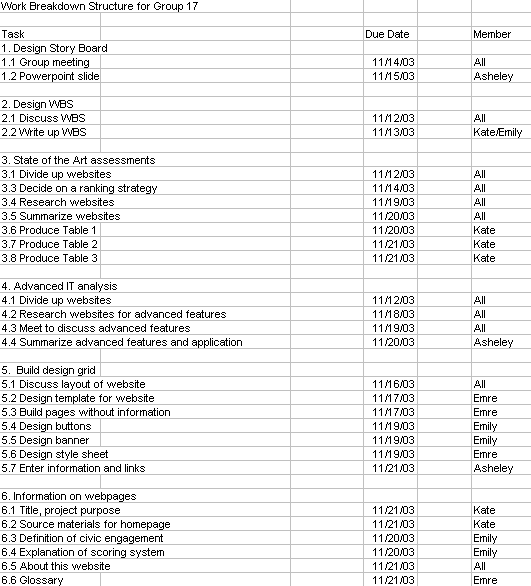
The following is a more realistic, although still very
small, WBS for a student project to conduct benchmarking
research on county e-government Web sites and then to present
the results in a Web site. More information about the project
can be found at
Innovations in eGovernment.