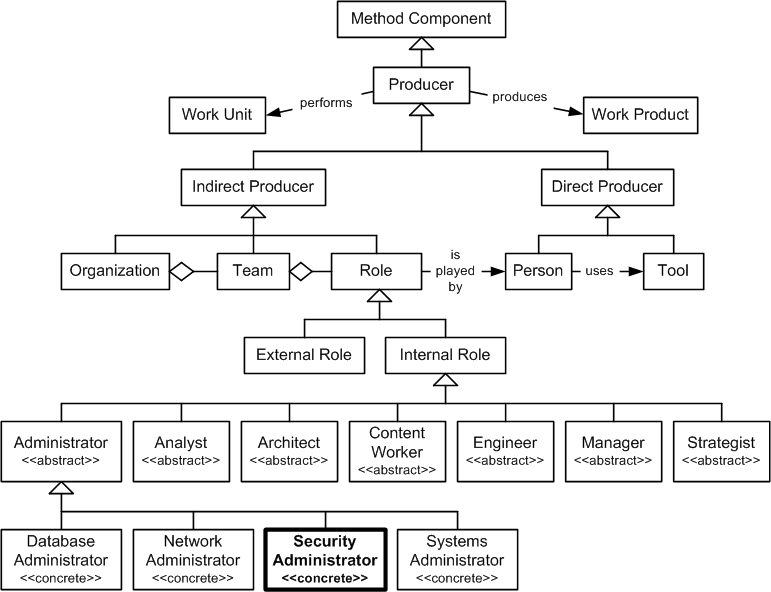
To fulfill these responsibilities, security administrators
typically should have the following personal characteristics,
expertise, training, and experience:
Security administrators typically should have the following
expertise:
Expert knowledge of security engineering tasks,
techniques, and tools.
Expert knowledge of security mechanisms:
Digital Signatures
Encryption/Decryption
Passwords
User Identifiers
Expert knowledge of security components
Expert knowledge of commercially available
security tools
Expert knowledge of the security aspects of:
Application Frameworks (e.g., Microsoft COM+, Microsoft
.NET, OMG CORBA, and Sun J2EE)
Application Infrastructure Components (e.g., BEA
WebLogic, IBM MQSeries, IBM WebSphere, iPlanet Directory,
MS Active Directory, MS BizTalk Server, MS Exchange, MS
IIS, MS Integration Server, MS MQ, SAP R/3, and Vitria
BusinessWare)
Databases (e.g., IBM DB2, Oracle)
Directories (e.g., iPlanet Directory Server, MS Active
Directory)
Operating Systems (e.g., Cisco IOS, Linux, IBM AIX, IBM
AS/400, MacOS, Microsoft Windows, Sun Solaris, Unix)
Servers (e.g., application, database, media/content,
messaging, and web servers)
Programming Languages
Security APIs and Protocols (e.g., DCE Security
Service, GSS-API, Kerberos, Microsoft CryptoAPI, PAM, PKCS
API’s, SAML, S/MIME, and SSL/TLS)
Solid knowledge of applications, contact centers, and
data centers.
Basic knowledge of the customer’s business and
application domain(s).